Local SEO audit checklist: 32 checks for a Google Business Profile and website
The LocalMapGrid team · Updated November 23, 2026 · 3 min read
The short answer
Use this checklist for your own business, or for a prospect or client. Each item says what to check and what good looks like. Work top to bottom: the early sections move rankings fastest.
1. Rankings across the area
Start here, because it tells you how big the problem is and where it is.
- Run a geo-grid scan for the main search term. Use the term a customer would type, like "emergency plumber", not the brand name. Good: top 3 across most points near the address.
- Record the top 3 share, the visible share and the average position. These are your baseline for every later comparison.
- Note who wins the points you lose. Those are the real competitors to benchmark against.
- Repeat for the second and third most valuable services. Rankings for "water heater repair" can look very different from rankings for "plumber".
2. Google Business Profile
- Claimed and verified. 11.9% of profiles in our data are unclaimed.
- Business name is the real name, with no added keywords or locations.
- Primary category is the most specific accurate one. Compare with the businesses in the map pack.
- Secondary categories cover real services only.
- Services listed individually, in customers' words.
- Description says what, where and for whom, in plain language.
- Hours complete, including holidays. 9.6% of listings show none.
- Phone number is a local number that's answered.
- Website link points to a real site, not a social page. 22.6% link to nothing.
- Address or service area set correctly. Service-area businesses hide the address.
- Photos: at least 10 real ones, with new ones added every month.
- Attributes filled in, such as accessibility, payments and online booking.
- No duplicates for the same business or address.
3. Reviews
- Review count against the local median and the leaders. "Enough" depends on the trade and city. Use the businesses in your own grid as the benchmark.
- Rating of 4.5 or higher. Most map-pack leaders sit there.
- Recent reviews. A steady flow beats a burst from two years ago.
- Owner replies to every review, especially negative ones.
- A review routine: who asks, when, and with what link.
4. Website
- Name, address and phone match the profile exactly.
- A page for each core service, linked from the menu.
- Location pages only for areas genuinely served, each with unique content.
- LocalBusiness structured data with name, address, phone, hours and geo coordinates.
- Fast and mobile-friendly. Most local searches happen on phones.
- Click-to-call visible on mobile.
- Title tags include the service and the area.
5. Citations and links
- Consistent listings on the main directories and data aggregators for your country.
- Trade and local association listings, such as a chamber of commerce or trade body.
- A few real local links, such as sponsorships, suppliers or local press.
6. Competitors
- Compare the profile with the top 3 rivals: categories, review count, photos and website.
- List the gaps that are fixable this month, in order of impact.
Turning the audit into a plan
Group what you found into three buckets:
| Bucket | Examples | When |
|---|---|---|
| Fix now | Claim the profile, fix the category, add hours, link the website | This week |
| Build | Review routine, service pages, photos every month | Over 1 to 3 months |
| Measure | Re-run the same grid scan | Every month |
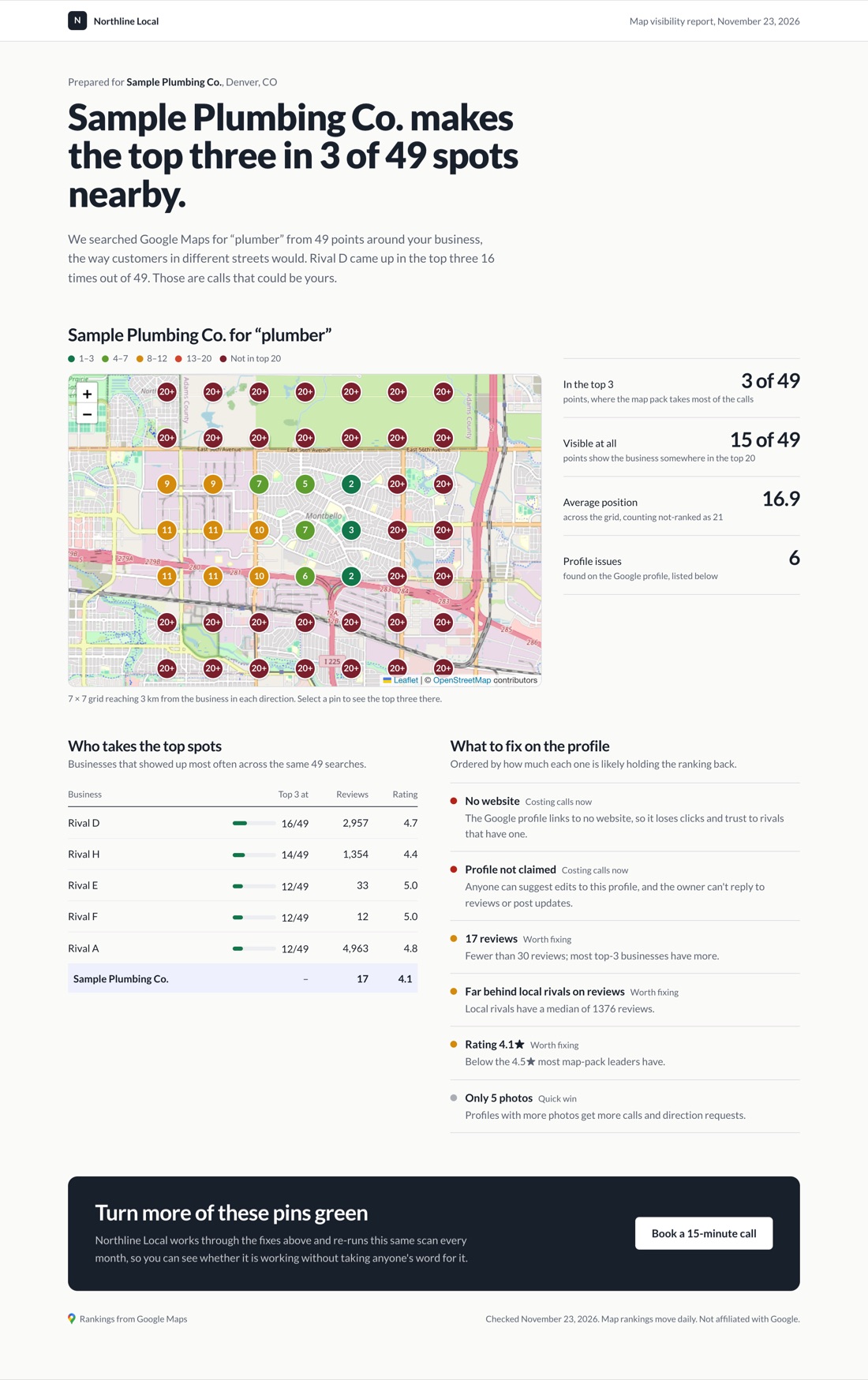
Auditing prospects at scale
If you're an agency, auditing one business at a time is slow. LocalMapGrid's prospect search runs the profile part of this checklist on every business in a trade and city at once, scores each one, and lets you turn any of them into a report with its own map.
Questions
What is a local SEO audit?
A check of everything that affects how a business ranks in local and map results: the Google Business Profile, rankings across the area, reviews, the website and citations.
How long does a local SEO audit take?
A thorough manual audit takes a few hours. The rankings map and profile check take about a minute with a tool like LocalMapGrid; the website and citations take longer.
What's the most important part of a local SEO audit?
Rankings across the service area and the Google Business Profile. They show where the business is losing customers and the fixes that move it fastest.
How often should I audit local SEO?
A full audit every six months, plus a monthly geo-grid scan to track rankings.