Local SEO pricing: what agencies charge and how to set your own prices
The LocalMapGrid team · Updated November 23, 2026 · 3 min read
The short answer
There's no official price list for local SEO, and anyone who quotes you exact "industry averages" is guessing. What's consistent is the structure of how agencies price, and the factors that push a price up or down. This guide covers both, and how to make the number easy for a client to say yes to.
Common pricing models
| Model | What it covers | Typical use |
|---|---|---|
| One-off audit | Profile, rankings map, reviews, website and competitors, with a written plan | Entry offer, or for owners who want to do the work themselves |
| Setup fee | Fixing the profile, categories, services, citations and basic website pages | The first month of a new client |
| Monthly retainer | Ongoing reviews, photos, posts, content, citations, reporting | The core of most local SEO businesses |
| Per location | A retainer multiplied, with a discount, across locations | Multi-location brands, franchises |
| Performance-based | Paid per lead or per ranking achieved | Rare. Hard to measure fairly and easy to dispute |
What drives the price
- Competitiveness of the trade. Law firms and med spas have already done the basics, so moving them takes more work than an HVAC company with no website. Our local SEO statistics show how differently trades start out.
- Size of the area. Ranking across a whole metro is more work than ranking around one neighbourhood.
- Number of services and locations. Each one is its own set of searches to win.
- Starting point. An unclaimed profile with no website needs a setup project before monthly work makes sense.
- What's included. Website builds, content, ads management and review software can all be bundled or sold separately.
How to set your own prices
- Price from the client's value, not your hours. If one extra job is worth $2,000 to a roofer, a retainer that brings one extra job a month is easy to justify.
- Separate setup from ongoing work. It makes the first month's bigger effort visible and keeps the retainer honest.
- Offer three levels at most. For example: profile only, profile plus reviews and content, and everything plus the website.
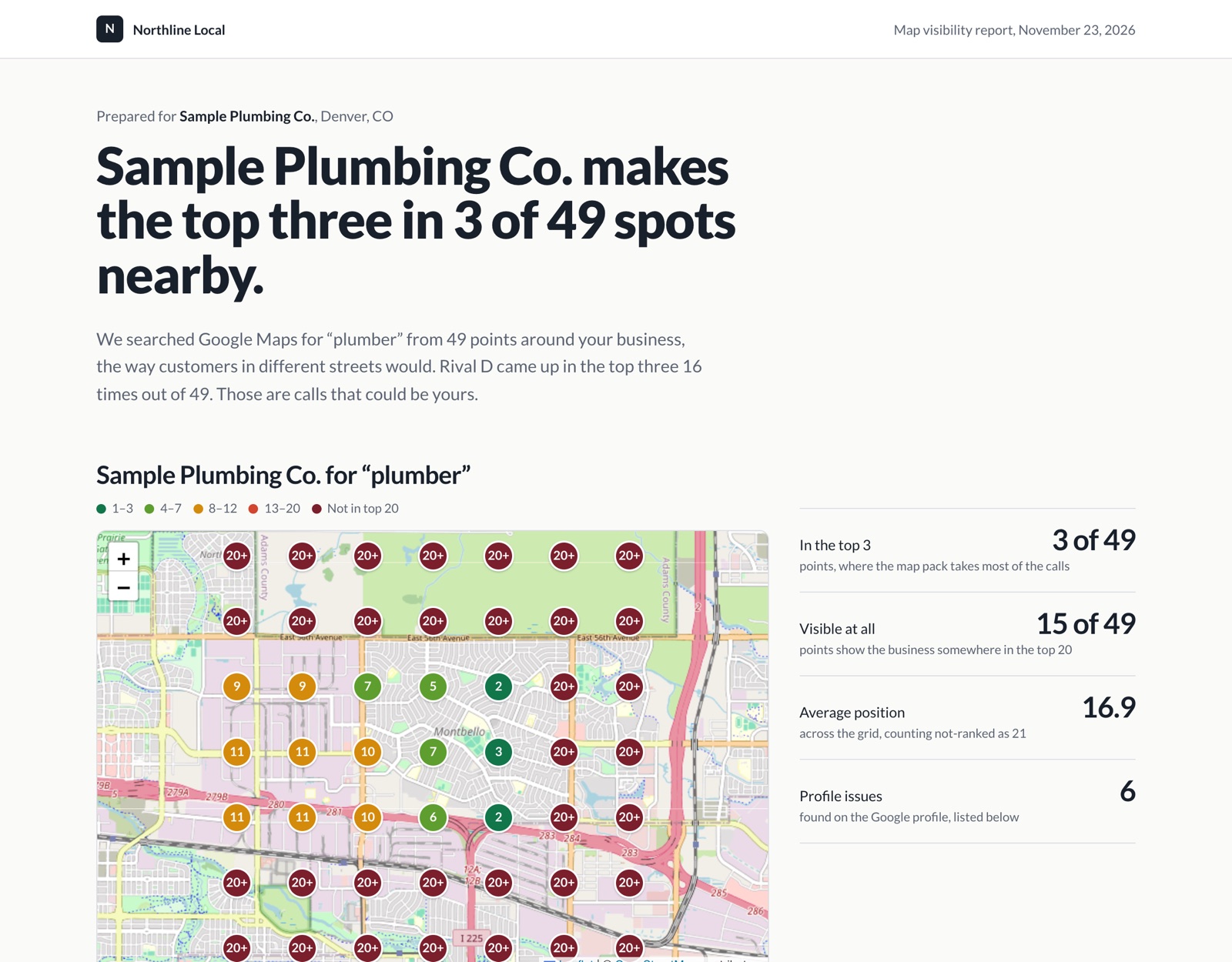
- Show progress the client can verify. Re-run the same grid scan every month and send the map. Rankings they can see are the best retention tool there is.
Use the map to justify the price
Owners don't buy "SEO". They buy more calls. A ranking map turns your price into a story they understand: here are the streets where you're missing, here's who takes those calls, and here's what it would take to win them.
What your tools cost
Your own costs matter for your margins. A typical local SEO stack includes a rank tracker, review software, a citation service and reporting. For finding and winning clients, LocalMapGrid's plans are:
| Plan | Price | Includes |
|---|---|---|
| Free | $0 | 5 prospect searches and 3 reports a month, grids up to 5 × 5 |
| Starter | $29 a month | 100 searches and 40 reports a month, grids up to 7 × 7, whole-metro searches |
| Agency | $79 a month | 400 searches and 150 reports a month, grids up to 9 × 9 |
One signed client covers a year of the Agency plan many times over. See how it compares with other tools in the best local rank trackers.
Questions
How much does local SEO cost per month?
Most agencies sell monthly retainers, commonly from a few hundred dollars for a small single-location business to a few thousand for competitive trades or several locations.
Is local SEO worth the cost for a small business?
It is if it brings more jobs than it costs. For trades where a single job is worth hundreds or thousands of dollars, one or two extra jobs a month usually covers it.
Should local SEO be priced per location?
Usually yes for multi-location businesses, because each location has its own profile, reviews and rankings to manage, often with a discount per extra location.
How do I show clients that local SEO is working?
Re-run the same geo-grid scan every month and send the map, along with calls and direction requests from the Google Business Profile.